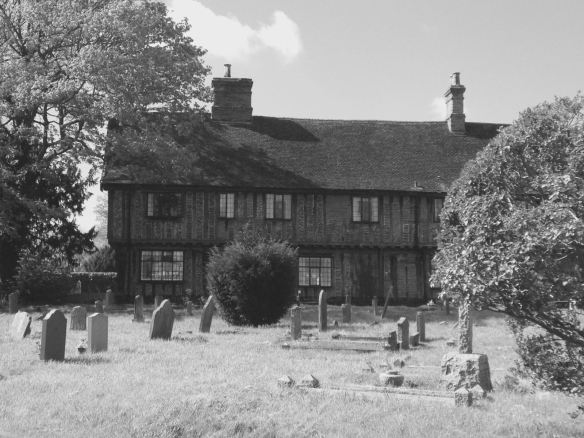
 Crucial to the setting of ‘The Fressingfield Witch’, is The Fox and Goose Inn which nestles in front of the churchyard. Formerly the guildhall of St Margaret of Antioch, the structure was built around 1509 and has been a public house since 1710. The side facing the churchyard is an attractive mix of brick and timbers and there is an interesting carved corner post with the figure of Saint Margaret on the church side of the building. The post, quite naturally, appears worn and I worked it into the book with one of the characters touching it for luck.
The village of Fressingfield in the book is populated with real inhabitants from the 1891 census, mostly where they do not play a lead role – and even sometimes where they do. The publican in 1891 was 63-year-old Benjamin Powley from Burlingham, Norfolk, coincidentally bearing the same name as one of my nephews. Prior to that, he was victualler at ‘The Feathers’ in North Walsham.
Though serving as a public house, The Fox & Goose regularly hosted inquests. The following, extracted from The Ipswich Journal 8th November 1884, records the inquest following the death of Jonathan Carter, an integral event in ‘The Fressingfield Witch’:
Sudden Death – An inquest was held at the Fox and Goose Inn on Monday morning before C.W. Chaston, Esq upon the body of Jonathan Carter, agricultural labourer, aged 77 years. Harriet Corbyn stated that the deceased, who was her brother, had lived with her and her husband for the last four years; he had had fair health and witness had not heard him complain. He left home about nine a.m. on Saturday to be shaved, which was the last time the witness saw him alive. Several of the family had died of heart disease. Deceased had not for a long time been attended by a medical man. Harriet King, widow, said that as she was walking through the churchyard on Saturday morning, about 10 o’clock, she noticed someone lying on the path, and on going up found it was the deceased. She spoke to him, but receiving no answer she went at once for assistance. John Edwards, baker, said that in consequence of what the last witness said to him on Saturday, he went into the churchyard and found the deceased lying as described. He breathed twice, and almost immediately afterwards expired. Dr Anderson stated that he had made an external examination of the body, and found no marks of violence. Judging from his experience and from the evidence given, he was of the opinion that death was caused by sudden failure of the heart’s action. The jury returned a verdict accordingly.
Today, The Fox & Goose is a popular, friendly restaurant attracting a range of satisfied customers and even coming to the notice of The Telegraph. It is a far cry from the place of torture assigned to its upper floor in the book – a place where Matthew Hopkins accused Faith Mills of witchcraft and tried to extract a confession using the cruellest methods. Nowadays, the only cruelty is having to choose from so many delicious menu options. Time has moved on, in a good way.
 Suffolk is a glorious place graced with rolling hills, salt marshes and sandy beaches. Charming villages and market towns lie scattered through the countryside while bustling seaside ports adorn the coast. Steeped in history, Suffolk has grown elegantly into the 20th century with towns like Bury Saint Edmunds enjoying the historic Abbey grounds as they blend harmoniously with sympathetically built shopping complexes and other modern structures. The Suffolk landscape is varied and naturally inspirational for writers. At least, it was for me.





 It’s the first day of a week away from work. The weather is disgusting. My dog is sullenly pacing round the house eyeing me with disapproval. It’s so foul outside, that today we are going nowhere.
 Jacqueline Beard Writer