A Grave Mistake

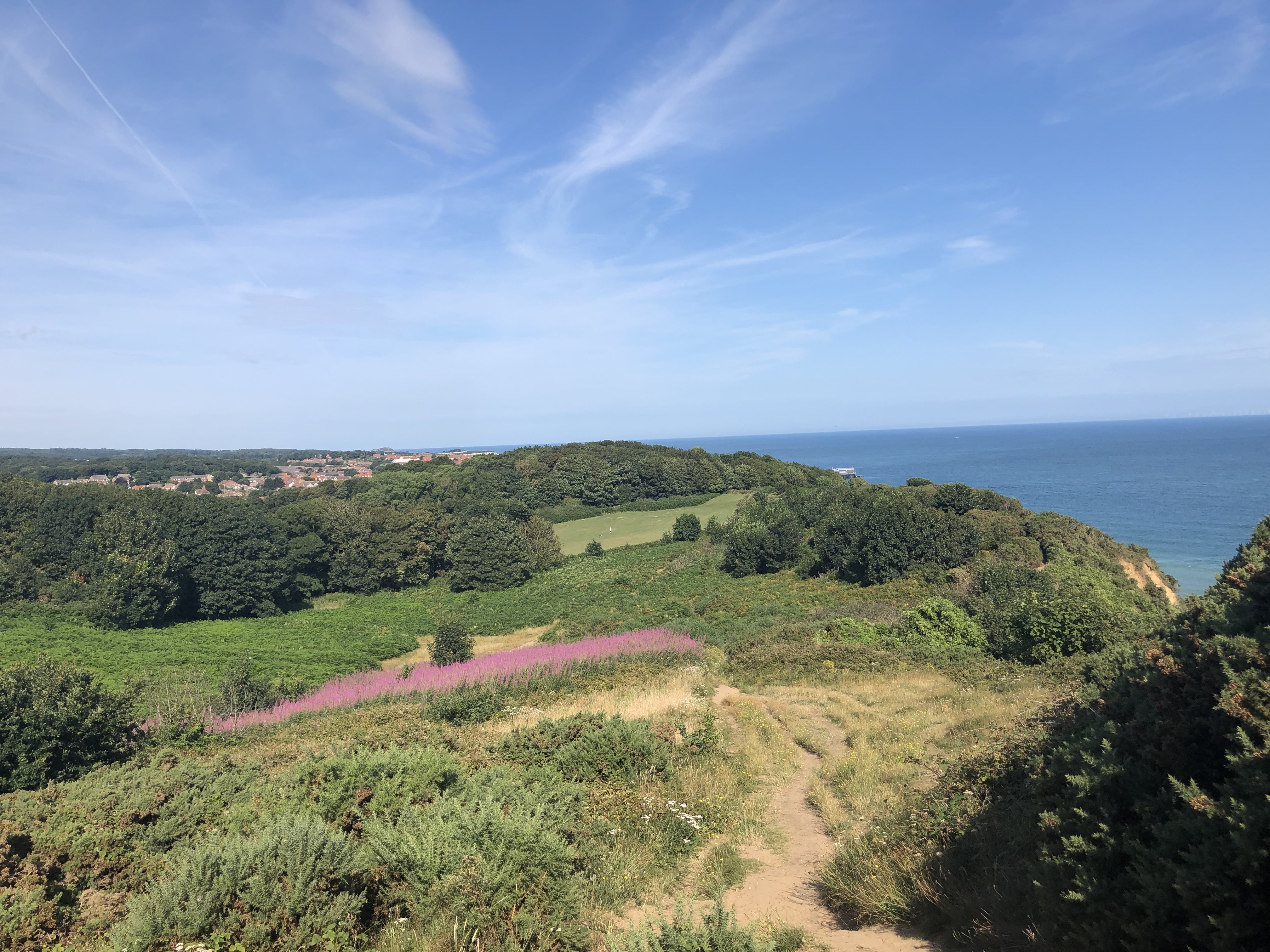
It’s raining today, miserable, and a good time for catching up with administration. I’ve just cleared out my writing files, cringing with embarrassment at my earliest efforts, but discovering other long-forgotten favourites like the flash fiction story below written for the 2018 Noirwich Crime competition. I’m fond of this piece. My lovely and sadly departed mother came from Overstrand, and her grandfather, Frederick Dennis, dug the first grave in the cemetery. As the short story says, by a quirk of fate, he ended up in it. The Cotswolds where I live are delightful, but I miss Norfolk, especially on days like these. Days where a brisk walk across the cliffs clears the cobwebs and soothes the soul. This story is for my mum and my Overstrand relatives & ancestors.

Rumour has it that old man Dennis dug the first grave in Overstrand cemetery. By a quirk of fate, he died soon after, and they laid him to rest there. It made me mindful of my mortality—no pauper’s grave for me. I signed up to the North Norfolk burial club sharpish together with the wife and nippers. We went hungry sometimes but always paid our dues. Better to starve than end up in the workhouse; better to shiver and have a decent final resting place.

But that was then.

Ten years on, and I long to dine on food not dragged from the ocean, warm my feet by a blazing fire, be my own man and make my own choices. No more turbulent seas, blistering chills, beaches dotted with crab pots. And no more Florrie.

My heart alive, but she was beautiful once. Her smile dazzled. I would have laid down my life to protect my Florrie. Now she is a hard-faced lump of a woman. Lazy too. She spends all day mardling with the fishwives and has no time for me.

Bessie Storey does, though. Little doe-eyed Bessie, younger and prettier than Florrie, has made no secret of her regard. Bessie is from a large family. She’ll make a good mother for my children.

‘Hold you hard,’ I hear you say. ‘Is poor Florrie dead?’

Not dead yet, but soon. There is money aplenty in the burial club and still more besides in our life insurance policies. Money scrimped and saved from my toil at sea – money I could have spent on ale, like every other red-blooded man – wasted, like my life.

Look, here comes Florrie now, plodding over the cliffs, her dumpling face set in its usual frown, demeanour as predictable as her Friday evening walk. Always the same routine. She visits her mother in Paul’s Lane before lumbering down to the cliffs, where she waits silently, staring out to sea. But why?

Florrie has seen me. She lifts her hand uncertainly and waves it in my direction. Her face, a mask of misery, shows no pleasure in my presence. What does she make of my intrusion? No matter. One minute or two – soon, she will be close enough. I will sidle towards her, smile and give her a little shove. The moment is perfect. It’s close to dusk, and there is not a soul around.

Florrie reaches me, piggy eyes searching my face. There are bristles on her chin. How did I ever love this woman?

It is time.

I move towards her but suddenly feel a weighty thud on my chest, then fall backwards, arms flailing. The Overstrand cliffs rush past me. I can smell the salty sea and hear the cackle of gulls–but is it? No, the sound is raucous laughter, and it’s coming from Florrie. I cannot see her, but before the world goes black, I sense her looking down at me, smiling as she did when we were young.
Writing Inspiration

It’s no secret that historical newspaper reports inspire my books. After all, there’s nothing quite as strange as the truth. In fact, the first book in the Lawrence Harpham series came from an article only a few paragraphs long. In short, I collect interesting stories from which books evolve.  I haven’t done anything with the account below – yet. But as the fire occurred in my ancestral village of Northrepps and George Woodhouse is in my family tree, it has all the components for one of my novels. That said, it’s important to acknowledge the real tragedies behind these stories. Many writers use famous historical characters, but I like to write about people seldom known outside their family and friendship groups. Yet there’s a fine balancing act between a good story, and treating our ancestors with respect, especially with the current popularity for genealogy. And it’s worth considering that people who lived their lives quietly and unobtrusively might be horrified to find themselves the subject of fiction if only they had known.

Norfolk News 17th December 1881

Northrepps – a sad case of burning.

A painful case of burning happened in this village on Tuesday night last, resulting in the death of Mrs F Golden.  The facts in connection with the sad occurrence, as they came before the deputy coroner Mr W H Scott, at an inquest held on Wednesday at the White Horse Overstrand, are as follows. On the night in question, sparks were seen going up from Mr Golden’s chimney by several persons, and an alarm was raised that the house was on fire.  Two men, Henry Jarvis and George Woodhouse entered by the back door and saw a fire on the hearth in the sitting room.

Woodhouse obtained three pails of water and threw upon the burning matter, which was found to be the body of the deceased.  The flames had devoured all the clothing, leaving the body completely charred.  A chair was found near the fireplace very much burnt.  Jane Bane, a domestic servant, said she last saw the deceased at about half-past seven when she had to leave to go out.  Mr Golden was away from home, and the deceased was left alone seated on a chair before the fire in the sitting room.  She was in her usual health.  There was no lamp of any kind, but one candle burning on the table, and a small coal fire.

Deceased was in front of the fire with her feet, as witness believed resting on the fender.  She did not appear either tired or sleepy.  The jury returned a verdict of “Accidental death by burning.” Deceased was 57 years of age.

As a fiction writer, I can’t take this article at face value and my default position is to suspect foul play. Why was Mrs Golden unable to get to safety? Did she try to escape? And if not, why not? Could supernatural forces be at work? Perhaps she was a victim of spontaneous combustion. There are so many why’s in this small piece.

I haven’t written the story yet, but I will. And that’s how my books begin, one news story at a time.

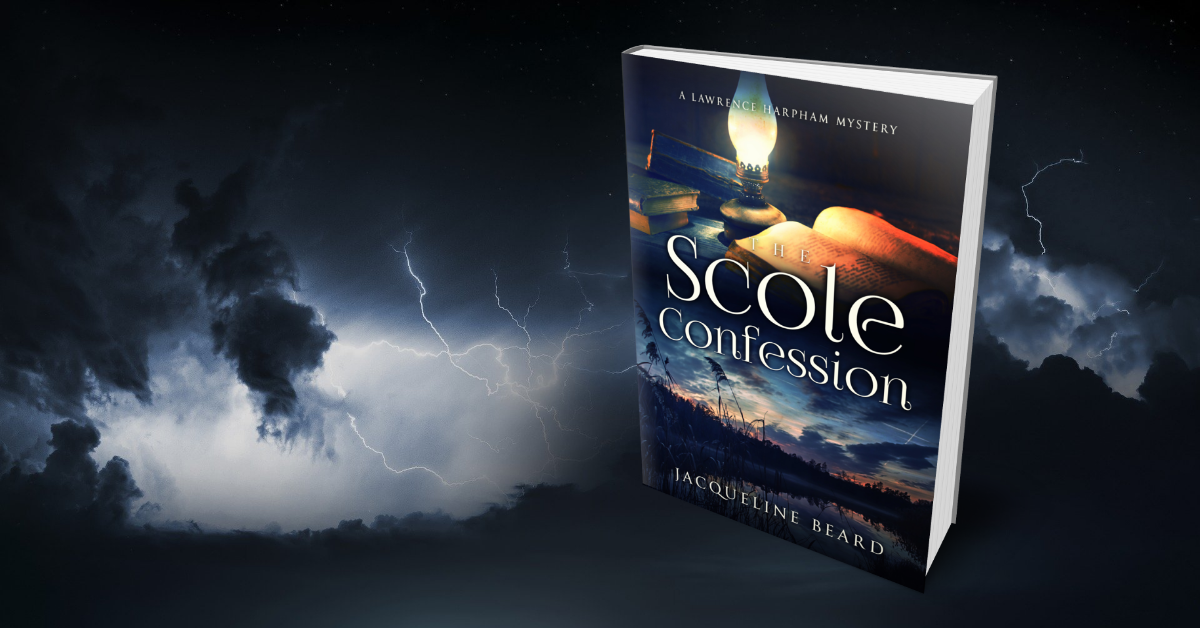
The Scole Confession – New Release

tsc-fb-engagement-ad


Overstrand 1895. Lawrence Harpham and Violet Smith are witnesses to suicide while on holiday. Beneath the body, lies a bible belonging to a murdered man.

Clues lead to the violent death of a bookseller and a chilling confession from the past. From Norfolk to Liverpool, investigations point to the unsolved murder of Fanny Nunn in the town of Diss. But how are the murders connected? Why do the parish registers contain so many unnatural deaths?

As Lawrence and Violet close in on the killer, Lawrence discovers a long-kept secret about his wife’s death. Can he overcome his demons, and will they stop the murders before more lives are lost?

CLICK HERE TO ORDER ON AMAZON KINDLE

CLICK HERE TO ORDER A PAPERBACK FROM LULU PUBLISHING


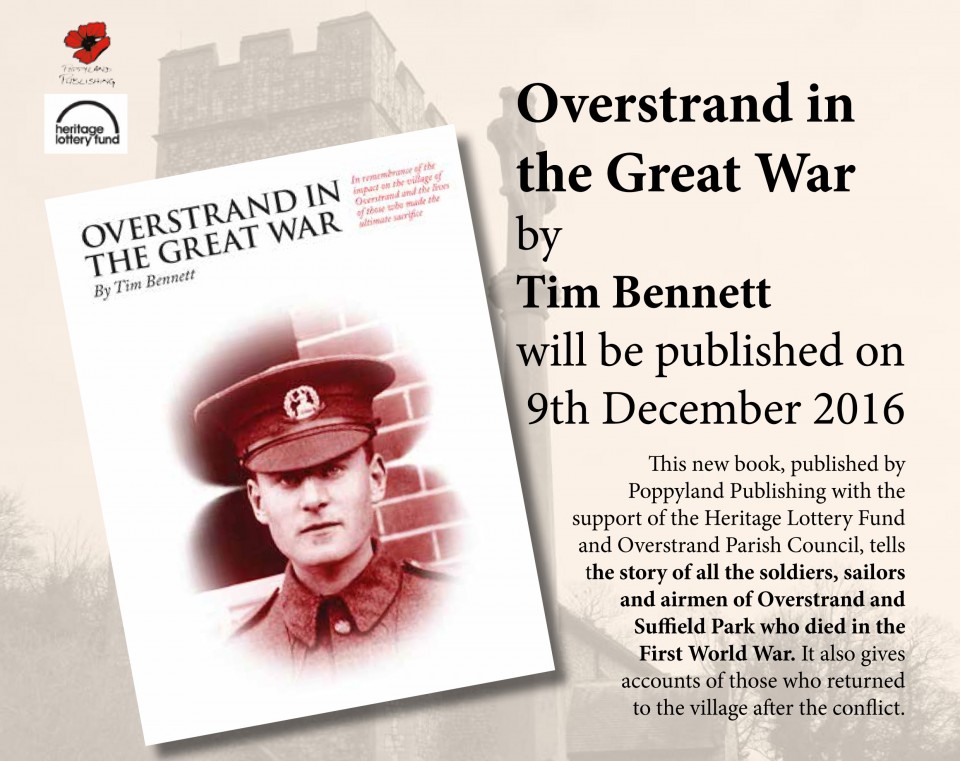
Overstrand in the Great War

overstrand-sales-leaflet_sm

This new book, published by Poppyland Publishing with the support of the Heritage Lottery Fund and Overstrand Parish Council, tells the story of all the soldiers, sailors and airmen of Overstrand and Suffield Park who died in the First World War. It also gives accounts of those who returned to the village after the conflict.

With 208 pages & colour throughout, ‘Overstrand in the Great War’ provides a fitting tribute to the young – and sometimes not so young – men and women of Overstrand and Suffield Park from a century ago.  General the Lord Dannatt kindly contributes a foreword and puts their sacrifice and service into the context of the continuing commitment required of our armed services.

Author – Tim Bennett

Military Research – Martin Dennis