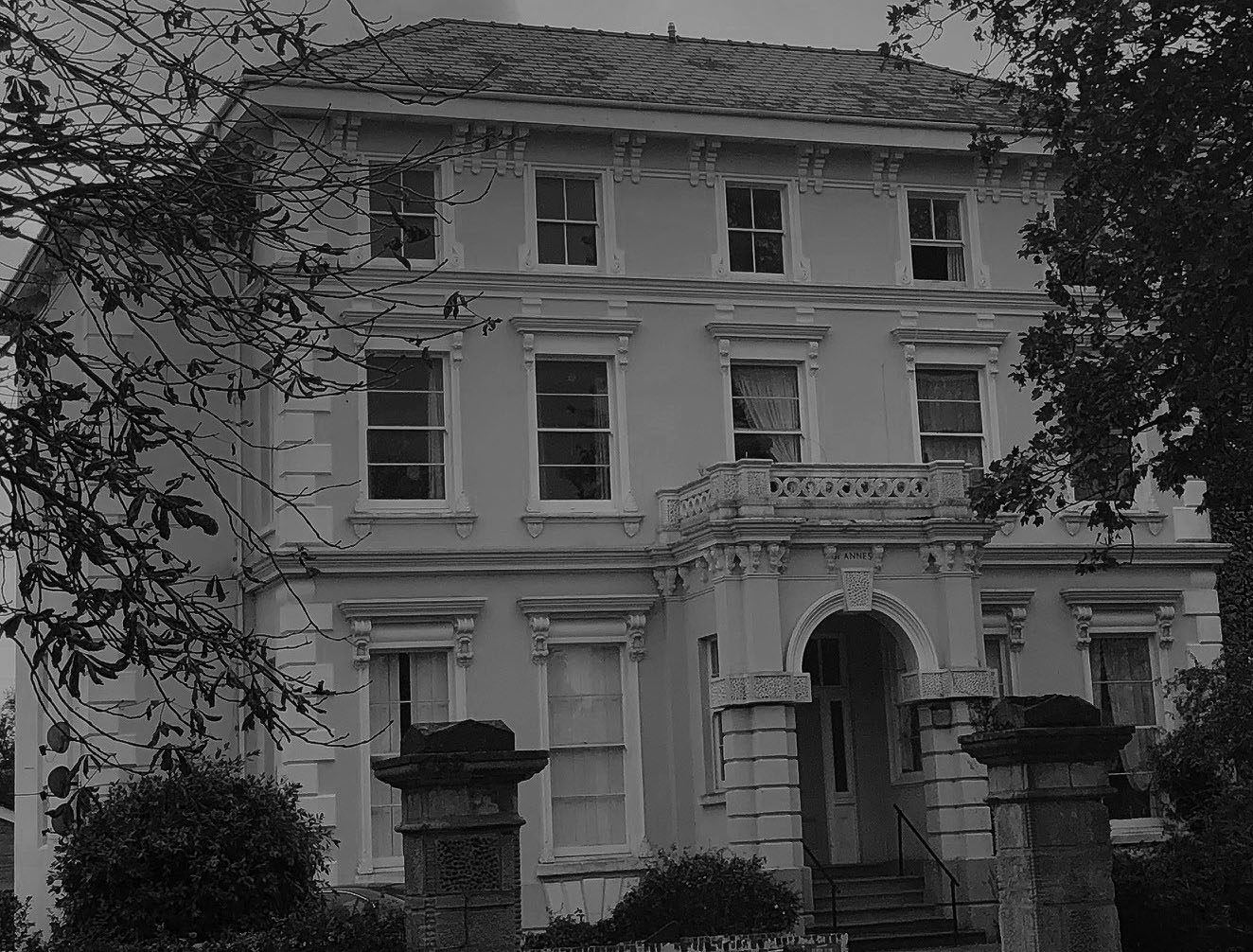
It’s mid-October and the clocks go back next week. Days are shorter, leaves are turning golden brown and the air is crisper as Autumn melds into winter. Frightmare returns to Over with scary rides and rows of bloated pumpkins and thoughts turn inevitably to Halloween. To ghosts, witches and undead things. Like the ghost of St Anne’s, Cheltenham’s most investigated haunting.
My new book is almost written. Set in Victorian England, it portrays the Victorian fascination with all things supernatural. And it was during Queen Victoria’s reign in 1860 that St Anne’s was constructed. Located on the corner of Pittville Circus Road, St Anne’s was a grand family residence set in extensive grounds. It had a sweeping carriage drive, 14 bedrooms, stabling for three horses and a gardener’s cottage.
The first occupants were Henry Swinhoe and his wife Elizabeth. Henry, born in Calcutta, was the son of a solicitor. He purchased the property from new and named it Garden Reach.
Rose Despard and her family moved into St Anne’s in 1882. Rose lived there with her father, her invalid mother and several siblings. Ten months after moving in, Rose saw the ghost for the first time. She described it as an apparition of a tall lady dressed in black widow’s weeds wearing a bonnet with a veil. The woman clutched a handkerchief to her face concealing her features. The ghost appeared many times over the years. Her footsteps were described as light, like ‘a person walking softly with thin boots on.’
Rose knew Frederick Myers, a founder member of the Society for Psychical Research. Myers investigated the haunting obtaining statements from witnesses including family, friends and servants. The report of the ghost gained serious credibility.
Rose’s account of the haunting appeared in the 1892 journal of the SPR. She identified the ghost as that of Imogen Swinhoe, second wife of the original owner. Rose’s investigations revealed that Swinhoe had turned to alcohol after the demise of his first wife. His new wife hoped to cure him of his intemperate habits but ended up becoming a drinker herself. According to rumour, Swinhoe had a special box constructed containing his first wife’s jewellery. The box was hidden under the floorboards in the front sitting room. Henry intended to keep the jewels until his children were of age. They would then receive them as an inheritance. Imogen disapproved and was critical of the way the children were being raised. The marriage became strained. Drunken quarrels ensued, and they separated a few months before Henry died.
St Anne’s or Garden House as it was called in her lifetime held awful memories for Imogen. It is hard to imagine why her apparition would return. After her divorce, she fled to Bristol. Her remains were returned to Cheltenham and she was interred at Holy Trinity with her mother.
Newspaper reports show that the Swinhoe’s marriage had broken down irretrievably by 1875. An article in the Cheltenham Mercury in April publicly declared that Henry Swinhoe would not be responsible for any of his wife’s debts.

Soon after, he instigated divorce proceedings. Henry’s divorce petition is available on the internet. It makes uncomfortable reading. He accused Imogen of gross and continual habits of drunkenness and violent and indecent language. On 22nd December 1874, Imogen allegedly threw a chair at him. On other occasions, she threw different articles of furniture. Henry claimed that her behaviour enfeebled him and was injurious to his health. A further incident occurred on the 5th of April 1875 when Imogen accused Henry of infidelity. She stated that he fathered an illegitimate child by their housemaid, Elizabeth Townsend. Henry’s children and the servants were witnesses to this accusation. Elizabeth was so distressed that she bought an action for damages.
The account in the divorce petition implies that Imogen was violent and unstable. But were things as one-sided as the evidence suggests? Local newspapers show otherwise. In 1874 Henry’s name appeared in the newspaper coverage of a case of slander. It involved the local milkman who had been wrongly accused of kicking a neighbour’s dog. Swinhoe had responded to the unproven allegation by taking his custom away. The judge called this action ‘foolish’ in his summing up. The Cheltenham Chronicle of 16th November 1875 covers an assault by errand boy Frederick Crisp. The assault was on Charlotte Wittington, a servant of Henry Swinhoe. It emerged, during the trial, that Swinhoe had threatened to shoot the boy. Within a week of this article, Henry Swinhoe appeared in court. Henry had an abhorrence of perambulators. He had pushed his stick into the side wheel of Alice’s Speechy’s pram to overturn it into the gutter. But for the prompt action of Alice Speechy’s nurse, the child could have fallen from the pram. Henry Swinhoe was found guilty and fined.
Both Henry and Imogen were obstreperous. But why? Henry’s ill-temper was borne of grief. His first wife died in childbirth. A poignant acknowledgement of his still-born son’s birth in August 1866 appeared in the papers. Henry became a widower with five young children. His marriage to Imogen in 1870 was likely made to provide them with a mother.
Imogen was the daughter of Major George Hutchins and his wife Catharine McEvoy. George died in 1844 and Imogen remained close to her mother. She was the sole executrix of Catharine’s will when she died in 1870. Catharine left a 7-bedroom property at 2 Blenheim Parade (off The Evesham Road). Henry let it in 1871 at a rent of £30.00 for the period from April to December, a far cry from today’s prices.

If not always cantankerous, Henry’s behaviour was far from gentlemanly. The incident with the pram could have resulted in serious injury, if not a loss of life. He was ill-tempered and unpleasant. The marriage was a disaster and it is likely that Imogen was unhappy from the outset. Turning to alcohol may have been the only way she could cope. There were faults on both sides.
But what of the ghost? Was it Imogen? Rose Despard thought so. Her research revealed no other candidates. The Swinhoe’s were the first owners of St Anne’s, constructed on the site of a market garden. Henry’s first wife died before him and never wore widow’s weeds. The next owner was Benjamin Littlewood, a Justice of the Peace. He purchased the property, which he renamed Pittville Hall, in 1879. Benjamin died six months later in the sitting room where Henry Swinhoe had hidden the jewels. This ruled out the possibility of Littlewood’s wife being the ghost. The house lay empty for some time before the Despard’s arrived and with them the beginnings of the haunting.
Most hauntings occurred in 1884, but sightings have continued as late as 1985. The ghost is usually seen in the house, but also in the gardens, in Pittville Circus Road and in the grounds of the opposite property. The ghost, if one believes in such things, has ties to the property. In the absence of any other candidate, it ought to be Imogen. But there is another person with tenuous links to the house. A person who lived nearby as a widow for many years, and who cared for Imogen until the end. Catharine Hutchins died the year after her daughter married Henry Swinhoe. She may have seen cracks in the marriage before she passed away. It is not difficult to imagine her desire to comfort her troubled youngest daughter. To visualise her lingering near the property where her daughter suffered for so long…
51.909211
-2.067896


 Jacqueline Beard Writer