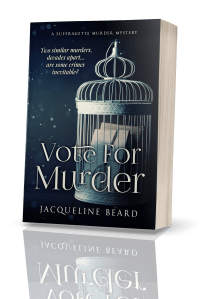
Vote For Murder

Scandal, Secrets & Suffragettes – Vote for Murder is FREE on Amazon Kindle until 4th March 2022. Get your copy here https://geni.us/VFM2

It’s 1911, and the women of Ipswich are making a peaceful stand against the unfairness of the voting system. Suffragist Louisa Russell joins the census evasion protest at the local museum. While exploring the back rooms, she finds a diary belonging to a prisoner – and not just any prisoner, but the infamous Mary Cage executed for murdering her husband James six decades earlier. When Louisa’s next-door neighbour dies under suspicious circumstances, the parallels between his death and James Cage’s poisoning become impossible to ignore. But can there be a link between two deaths sixty years apart? And will Louisa find the poisoner before an innocent woman is convicted?

Vote for Murder is historical fiction based on a true Suffolk crime.

A New Cover for an Old Book

Vote for Murder – new & updated

It’s 1911, and the women of Ipswich are making a peaceful stand against the unfairness of the voting system. Suffragist Louisa Russell joins the census evasion protest at the Old Museum in Ipswich. In a quiet moment, she explores the back rooms of the museum and finds a diary belonging to a prisoner – and not just any prisoner, but the infamous Mary Cage executed for murdering her husband six decades earlier.

When Louisa’s next-door neighbour dies under suspicious circumstances, the parallels between his death and the poisoning of James Cage become impossible to ignore.

But can there be a link between two deaths sixty years apart? And will Louisa find the poisoner before an innocent woman is convicted?

Vote for Murder is a historical fiction novel based on a true Suffolk crime.


Opium – “Mother’s Friend.”

Glass Pharmacy Bottles with old  Labels

A number of poisons are referenced in Vote for Murder, as one might expect in a murder mystery.  Mary Cage, despite her poverty, was an opium eater.  This use of drugs, among the poorest in Victorian society, might seem unlikely but opium was, in fact, readily available and extremely cheap.  To put it in context, it was possible to purchase a quarter of an ounce of opium for the same price as a pint of beer.  In East Anglia, opium was widely sold in pills and penny sticks.  In other parts of the country it was dispensed as “poppy tea.”

Opiates or laudanum, caused episodes of euphoria, but these highs were followed by bouts of depression, slurred speech, restlessness and poor concentration.  Long term use of laudanum caused addiction but there were other short term symptoms including muscular aches, abdominal cramps, nausea, vomiting and diarrhoea.

Perhaps the most concerning use of opiates, was as a ‘quietener’ for children.  Mary Cage used opium pills to subdue her children in Vote for Murder:

“…two nights with no sleep has a remembering effect and I crushed the pills down and the children lay torpid and quiet about me, as Mary Ann and James had done those many years before.”

The use of opiates to subdue children was common place in working class households. Proprietary medicines were manufactured for the express purpose of calming children.  Godfrey’s cordial, a preparation of opium, water and treacle, was known as “mother’s friend.”

With the sale of drugs unrestricted and little or no direction on how to use opiates, deaths of children were inevitable.  The article below, from the Nottingham Evening Post 22 June 1907, recounts the sad demise of Aubrey Samuel Barnes:

Nottingham Child’s Death

An inquest was held at Leen-side this afternoon touching the death of Aubrey Samuel Barnes aged ten months, whose parents live at 144, Portland Road, Nottingham.

Kate Elizabeth Frances Barnes, the mother of the child and the wife of Frederick William Barnes, lace manufacturer, said deceased had suffered from bronchitis and constipation and had been under Dr. Roberts’ treatment.  She had also given it a cordial which she obtained some time before for herself.  On the label of the bottle was inscribed, “Infants’ Cordial. Poison.”  She obtained it from Mr. J.G. Wildgoose, chemist, of Alfreton Road.  There were no directions on the bottle.  She gave the child a dose at midnight on Wednesday.  On the following day she sent for Dr. Smith, who paid frequent visits, but death took place in the evening.

Dr. Smith stated that when he saw the child on Thursday morning it was in a state of collapse from narcotic poisoning.  It was a puny infant, and had evidently suffered from bronchitis.  Witness ascribed death to bronchitis, accelerated by narcotic poisoning.  The cordial referred to contained opium. Opium was very detrimental to children under twelve months, although it was a common thing for parents to give it.  In some parts of Nottingham, the common use of laudanum amounted to an abuse.

John Wildgoose, chemist, of Alfreton Road, said that the cordial which he sold contained a preparation of opium.  A spoonful of the cordial would have about a sixth of a grain of opium.

The Coroner suggested to witness that he ought to put the prescribed dose on the label, especially as the cordial was taken by both adults and infants.

The jury found that death was due to misadventure, and expressed the opinion that the chemist should state in future on the label the amount of the dose that should be taken.

English Murder Mysteries

Agatha ChristieChecking through my Goodreads books yesterday, I realised how deeply entrenched my book tastes have become.  Everything I enjoy most is set in England and involves a good old-fashioned murder, preferably not too graphic.  Not surprising really since I was bought up on a diet of Agatha Christie & P G Wodehouse.

This intransigent reading habit was one of several reasons I joined a book club.  I thought it would be good to expose myself to other genres.  In the last six months I have read A history of Lonliness, The Cellist of Sarajevo, Rebecca, The Life of a Banana, Tuesdays with Morrie and The Boy that Never was.  And a depressing bunch of books they are, let me tell you.  Rebecca is the shining star amongst them (although I enjoyed The Cellist of Sarajevo).  But if there’s one thing I have learned from the book club experience, it’s that I like what I like.  It may not be highbrow literature, it’s not Booker prize winning stuff, but the books I love have a beginning, a middle and an end – and above all else, they have a plot!

So it’s English murder mysteries all the way for me, particularly anything with a family history or genealogical twist.  My top six of all time, in no particular order, are:

Agatha Christie – Crooked House

Robert Goddard – Past Caring

Val McDermid – The Wire in the Blood

Susan Hill – The Various Haunts of Men

James Ruddick – Death at the Priory

Dan Waddell – The Blood Detective

I’m sure there are many deserving English murder mysteries that should be on the list.  There are several up and coming genealogy writers (Nathan Dylan Goodwin springs to mind) and some debut authors (Paula Hawkins – The Girl on the Train) who have captured my attention.  Who are the best all time English murder mystery writers?  Your suggestions would be appreciated.

Intellectual inferiority & other excuses…

Millicent FawcettIt is interesting to read reports of early attempts to promote the case for women’s suffrage.  In this extract from the Bury Free Press, July 1871, Millicent Garrett Fawcett argues against multiple reasons given by men (and anti-suffrage women) against emancipation. She counters all arguments rationally and eloquently, but forty years later the government of the day still refused to grant votes to women.

“Mrs Fawcett, who, on presenting herself, was loudly cheered, then proceeded with her lecture, which was a resume and refutation of the argument used by the opponents of women’s rights to the franchise in the House of Commons on the second reading of the Woman Suffrage Bill. 

These arguments she enumerated as follows:  That women were represented already, that to give them votes would be to give two votes to their nearest male relation, or to their favourite clergyman; that it would occasion domestic broils; that it would destroy family government, which was necessarily despotic; that women were intellectually inferior to, and physically weaker than men, and therefore ought not to have the franchise; that home was woman’s sphere, that women were superior to men, and would be deteriorated by contract with the ruder life of men; that the line must be drawn somewhere for if women got votes they would demand to be admitted to Parliament; that women did not want votes; that women were by nature conservative; that women could not be soldiers; that the deference and courtesy now shown to women would be lost; that women suffrage would be destructive of the foundation of society, and obliterate the distinctions of sex; that the Bible said nothing about it; that reason must prevail; that authority was against it. 

To each of these objections Mrs Fawcett replied seriatim, and concluded by contending that the suffrage was not only woman’s right, but that woman, man and society would be improved by her possessing it.  She was much cheered, and received the thanks of the meeting, as did Sir R Murchison for giving the use of the theatre.

Mistreatment of Suffragettes

Women’s suffrage was newsworthy and accounts of suffragette militant exploits were often reported nationally, usually negatively.  The cruel treatment of those suffragists engaged in acts of peaceful protest is often conveniently forgotten.  The two accounts below, taken from The Framlingham News, portray the shocking treatments suffragettes were subjected to in the course of their fight for the vote.

Framlingham Weekly News 10th Oct 1908 The Suffragette

Suffragettes Ill-treated

Mrs. Despard and Miss Margaret Sidley, who visited Maidstone in the Suffragist van on Wednesday evening, were subjected to brutal treatment.  They had announced an open-air meeting, and a crowd of 3,000 assembled.  The Suffragettes were received with showers of granite chippings with which the road was being repaired.  A stone struck Mrs. Despard on the forehead, inflicting a nasty abrasion.  She pluckily mounted a chair and faced the crowd, who pushed her off the chair and smashed it.  When the van arrived the suffragists abandoned the attempt to speak, and barricaded themselves within.

Deliberate attempts were then made to over-throw the van, which was pushed uphill and allowed to descend by its own momentum.  Only by the narrowest shave was disaster averted.  The windows of the vehicle were smashed, the tailboard was wrenched off, rotten eggs and other missiles were flung, the imprisoned ladies being kept in a state of terror.  At length the police intervened, and amid much booing the van was driven away.

Framlingham Weekly news 8th March 1913

In Hyde Park on Sunday afternoon Mrs. Flora Drummond and several other members of the women’s Social and Political Union were made the object of hostile attentions of a huge crowd and were persistently pelted with pieces of turf.

Members of the crowd sang, danced, waved sticks, cheered and hooted in turn, and the statements of the speakers were greeted with cries of “You ought to be tarred and feathered,” and other similar taunts.

One suffragette was struck in the eye and another in the mouth.  Mrs. Drummond’s hat was disturbed with a walking-stick, which became entangled in her hair.

Another speaker had a fierce tussle with a member of the audience who attempted to board the platform.  Later the same woman injured her wrist in a tug-of-war for possession of a spectator’s stick.

At the close a formidable rush was broken by the police escort.

On Sunday afternoon an attempt by suffragettes to hold a meeting on Wimbledon Common led to disorderly scenes.

After the speakers had vainly endeavoured for half an hour to obtain a hearing, amid the blowing of motor horns and the singing of popular songs, the crowd closed in on the platform, the suffragettes were dragged off and despite efforts of the police to protect them, three of the women were knocked down.

An exciting scene was witnessed in Oxford-street on Saturday afternoon, when two suffragists, who during the morning had been playing a piano in the West End, were attacked by a couple of men, and in the skirmish which ensued the piano organ was upset and considerably damaged.

The women, both of whom are London members of the Women’s Social and Political Union, were engaged in the week’s self-denial campaign, which opened that day, and were thus engaged with the object of gathering funds on behalf of their union.

In the face of such hostility, it is easy to imagine why some women felt they could not expect to advance their cause through peaceful demonstration.
Women’s Suffrage October 1915

When war broke out in 1914, all militant suffragette action ceased.  From that point, all focus was on the war effort.  The following extract is typical of the patriotism of both suffragists & suffragettes.

Sevenoaks Chronicle and Kentish Advertiser 15 October 1915

The National Union of Women’s Suffrage Societies

(Non-Party and Non-Militant)

Contains over 602 Societies and 16 Federations

President:

Mrs. Fawcett L.L.D

President:

Countess Brassey

Hon. Treasurer

Miss Druce, Thornhill, Sevenoaks

At this crisis the N.U. has suspended political activities in order to utilise its large organisation for the relief of distress caused by war.  It desires to illustrate the truth that Suffragists desire duties rather than rights, and that their ideal is the service of humanity.

Politicians & Women’s Suffrage in Britain

Herbert AsquithIt is fascinating to read historical newspaper accounts of women’s emancipation which expose attitudes markedly different than those today.  Two contrasting newspaper articles about liberal politicians show remarkable differences in values, from which today’s politicians could draw a lesson.  The first article, reported in The Bury & Norwich Post 14 June 1898, shows a politician with considerable personal integrity, prepared to leave the Liberal Union due to their opposition to the “modest and reasonable” wish for women to have the vote.  He felt unable to serve an organisation with values so incompatible with his own.

Mr Jacob Bright on Liberalism and Women’s Suffrage

“A Cowardly and ungenerous Attitude”

The treasurer of the Manchester Liberal Union has received from Mr. Jacob Bright, formerly for many years MP for Manchester, a letter giving the reasons for not renewing his subscription of £50 to the Union.  Mr Bright writes: “Ever since I entered political life I have advocated the claim of women to Parliamentary representation.  For the last thirty years my wire, my sisters, my nieces and almost without exception, the women connected with my family, have given much labour to the cause of the enfranchisement of their sex.  I have never been satisfied with the attitude of the Liberal party towards this question.  I think it has been and is a cowardly and an ungenerous attitude.  I see that the hesitation, not to say hostility, with which certain leading liberals treat a claim so moderate and reasonable is seriously undermining the very foundations of the Liberal creed.  Considering the length of time which has elapsed since the principle and taxation and representation should go hand in hand was established, it is only just that women should be at once admitted to their share in the government of the country as they contribute to maintain.  For these reasons I have reluctantly decided that until Women’s Suffrage is seriously adopted and pressed forward as a measure of immediate Liberal policy any means at my disposal must be given to those who at great personal cost and labour, are advocating a reform which I hold to be essential.

Jacob Bright’s support for the cause is strikingly different to that of Herbert Asquith..  This may be due, in part, to the change from the peaceful tactics of the suffragists to the law-breaking of the suffragettes over the intervening years.  The attitude of Liberal Prime Minister Herbert Asquith following the second reading of the conciliation bill was reported in the Framlingham Weekly News 6th April 1912.  The conciliation bill, narrowly defeated by 14 votes, would have given voting rights to about a million women.  It was reported that, upon defeat of the bill, politicians leapt to their feet waving papers and handkerchiefs, cheering enthusiastically.  The vote was opposed by Winston Churchill and, of course, Herbert Asquith, amongst others. Asquith stated that his opposition was based on the one word, “sex.”

He said, “As a student of history and of political life, there is, in my opinion, a natural distinction of sex which admittedly differentiates the functions of men and women in many departments of human activity.  That differentiation ought to continue to be recognised, as it always has been, in the sphere of Parliamentary representation.”

Asquith was the target of many Suffragette attacks, during one of which the Downing Street windows were broken.  He fundamentally disapproved of militant action and it was not until 1917 when women ceased militancy to concentrate on the war effort, that he came around to the idea of women gaining the vote. Women over 30 or women householders over 21 were finally granted the vote by the last serving Liberal Prime Minister, David Lloyd George, in 1918.

Double booking for the hangman….

NooseDuring my research for Vote for Murder, I came across the following extract  in a letter from P Jones to his friend and cousin Major Jones in which he mentioned murderess Mary Emily Cage, my inspiration for the book.  The letter entitled,  The brutality and cruelty of the British people , describes several British murders during 1851 including two Suffolk murders & the Chelmsford poisoning.  He claims that “such occurrences are seldom or never heard of in our southern states”.

A HIGH-SHERIFF IN DIFFICULTY; OR, A HANGMAN WANTED

“It will no doubt be in the recollection of many persons that the High Sheriff of Suffolk, in March last, was placed in no very pleasant position in consequence of the services of a hangman not being obtainable to carry into execution the last sentence of the law upon Maria Clarke, for the murder of her illegitimate child, by burying it alive in the parish of Wingfield. The high-sheriff, however, on that occasion, was spared an unpleasant duty by a reprieve coming down for the condemned woman two days before that on which her execution was to have taken place. At the assizes held at Ipswich, on the 2d inst., Maria Emily Cage was found guilty of the murder of her husband, James Cage, at Stonham Aspel, by administering to him a certain quantity of arsenic. Her execution was ordered to take place on Saturday (Aug. 16), in front of the Ipswich county jail, but the same difficulty was again presented as in March. Calcraft, the hangman, on being applied to, could not attend, as he had promised to perform a similar office the same morning at Norwich. An application was next made to the hangman at Warwick jail, but that functionary could not attend, as he would be similarly engaged at Shrewsbury on that day. A messenger was then despatched to the Secretary of State’s office, who explained the unpleasant position in which the high-sheriff of Suffolk was placed, and requested that the execution of Mary Emily Cage might be postponed. The answer from the Secretary of State was to the effect that no alteration as to the day named could be made; thus leaving the high-sheriff to get out of the difficulty in the best way he could. To have had the law carried into effect on Saturday would, in all probability, have been repugnant to the feelings of the high-sheriff, for, as no person could be found to supply the place of Calcraft, the high-sheriff must have performed the horrid duty himself. To avoid doing that, the high-sheriff has, on his own responsibility, ordered the execution to be delayed until an early day in the ensuing week. The condemned woman’s demeanor is becoming her awful position. She appears to be resigned to her fate, but protests that she is innocent. The unpleasant position of the high-sheriff, not only on this but on a former occasion, may be attributed to the usual course not being adopted—the making sure that Calcraft can attend before any day be appointed for the execution.”— The Times, August 17th, 1851.

It must have been rare for an execution to be delayed for want of an executioner, but there were an unusually high volume of death sentences that year.  Somewhere in the region of 50 death sentences were handed out in 1851, resulting in the public hanging of 3 women. Despite the delay recorded above, Mary Cage was ultimately executed by William Calcraft – the longest serving executioner.  Calcraft executed approximately 450 people,  34 of whom were women.