Unraveling Intrigue: Lawrence and Violet’s Next Chilling Mystery

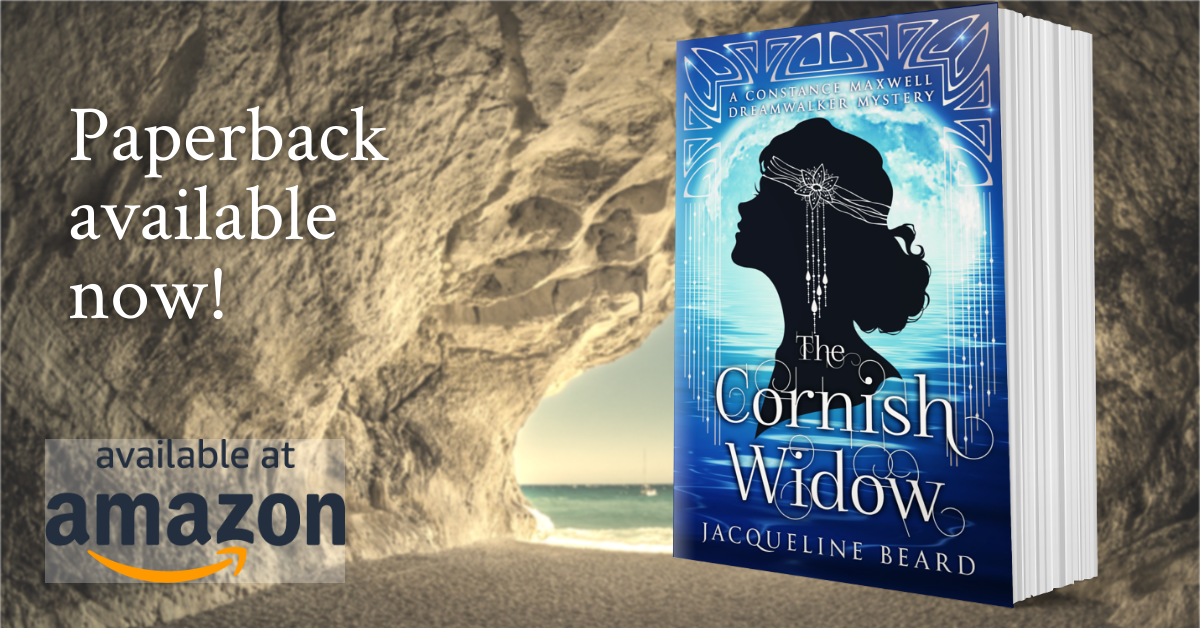
With Aurora in hiding, Frank Podmore missing, and old foe Felix Crossley on the prowl, Lawrence and Violet’s tranquil retirement is shattered. A tragedy in Malvern pulls Lawrence into the orbit of Arthur Conan Doyle, who challenges him to solve a chilling mystery from the past: uncover the truth behind years of anonymous letters and the wrongful conviction of George Edalji.

But as their investigation deepens, danger tightens its grip. When their landlady is poisoned and Lawrence narrowly escapes a deadly attack, it becomes clear they’re on the verge of exposing secrets someone will kill to keep buried.

Meanwhile, Crossley’s shadow looms ever closer, and Lawrence must confront a grim reality—escape may no longer be an option.

Pre-order details coming soon – ebook release 26 February

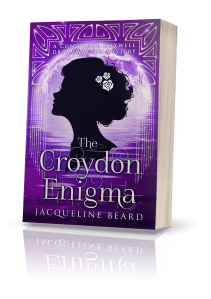
The Croydon Enigma – Ready to Order Now

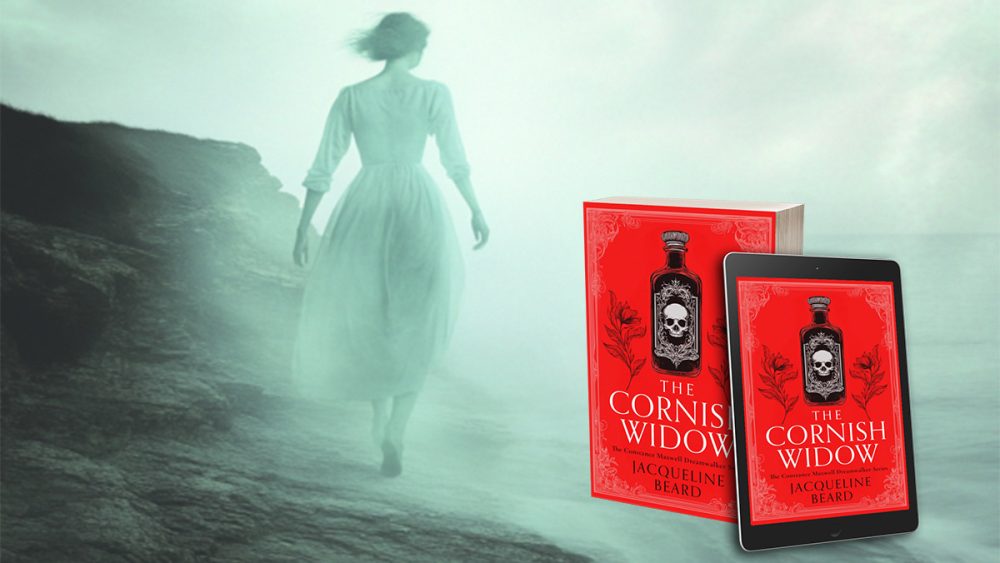
Accused of a crime she didn’t commit, Connie flees Cornwall in despair. But with Oliver Fox’s help, she begins an independent life complete with a fledgling romance. Connie’s new world is looking promising until she finds herself embroiled in yet another murder. Worse still, Felix Crossley has arrived in London, and is already in hot pursuit.

With the odds stacked against her, can Connie stay one step ahead of Mrs Ponsonby? Why is Crossley determined to find her, and what are his intentions?

The Croydon Enigma is the second book in this gripping 1920s mystery series with a supernatural twist.

Available on paperback or Kindle ebook. https://geni.us/TCEnigma

***FREE IF YOU SUBSCRIBE TO KINDLE UNLIMITED***

The Moving Stone

Now available for pre-order on Amazon Kindle

When a series of vanishings turn into murders, Lawrence Harpham is summoned to West Ham. Estranged from Violet and temporarily partnered with an oddball reporter, Lawrence pursues a ruthless serial killer.

Meanwhile, Violet’s contentment with her new life in Norfolk ends abruptly. What is causing the sinister movement of a gravestone, and who is following her?

Recently revealed secrets shatter everything Lawrence thought he knew about his past. Will Violet and Lawrence meet again? And will he ever recover from the horrifying revelations?

“That’s not what I mean,” gasped the hooded man, before lapsing into a coughing fit.
“Start at the beginning,” said Higgins. “I want every last detail, and if I get it, then you get to keep the rest of your fingers.”

The Moving Stone is a historical murder mystery based on real events. Click here to pre-order your kindle e-book.

The Fressingfield Witch audiobook

And it’s here. The Fressingfield Witch launched on audiobook today read by Andrew Cullum and is available at the following retailers:


– Audible/Amazon
– Storytel
– Apple
– Google
– Kobo Rakuten
Next up – The Ripper Deception on 19th November


The Mysterious Deaths in the SPR

One unexplained death at the heart of an organisation is unusual, but three inexplicable deaths within a small group of friends seems more like the plot of a murder mystery novel. Yet that is what happened to Edmund Gurney, Arthur Myers and Frank Podmore, each of whom held important positions within the Society for Psychical Research.   

Edmund Gurney was first to die in 1888 and his death, covered in a previous blog post, was caused by an overdose of chloroform.  Gurney had dined with MP Cyril Flower the evening before and was described by his friend as ‘in good health and with brilliant conversation.”  Flower detected nothing abnormal or untoward in his behaviour. 

Next to die was Arthur Thomas Myers, brother of Frederic William Henry Myers who was President of the Society for Psychical Research from 1900 until his death in 1901.  Doctor Arthur Myers, a close friend of Edmund Gurney, died of asphyxia caused by an overdose of Chloral Hydrate in January 1894.  Mr G W Protheroe of King’s College, Cambridge dined with Myers on the Monday before his death.  He described the doctor as ‘very cheerful’ and said that he had spoken about a journey he was due to undertake to visit a relative. Once again, there was no indication of low spirits. 

The following years were quieter.  Frederic Myers died a natural death from Bright’s disease in 1901. Then, on 14th August 1910, Frank Podmore went missing from his home in Malvern.  

Podmore, who had been staying with Mr and Mrs Cross at 2 Ivy Cottages, The Wyche near Malvern Wells, disappeared on a rainy Sunday evening.  A thunderstorm in the early hours of the morning had disturbed Mr Cross who noticed that Frank Podmore was once again absent from the home, having already left the property several times that day.  The alarm was raised the following morning, and a search party organised but to no avail. Then, on Friday, Podmore’s body was found in a large pool adjoining the Malvern Golf Links.  There were no marks of external injury, and the body was removed to the mortuary. 

Frank Podmore had been composing a letter to his mother before leaving Ivy Cottages for the final time.  It was never completed.  His watch stopped at 11.23 pm precisely, and there is little evidence to suggest that he slipped and fell during the storm.  The jury at the inquest returned an open verdict of “found drowned.”  Mr George Podmore, brother of Frank, said that his brother was always of a particularly cheerful disposition and had been enjoying his holiday in Malvern.  He further added that his brother had always upheld the sacredness of human life. 

Three men, all members of the same organisation were reported as in good spirits at the time of their demise.  So, what happened?  In his book, ‘The Strange Case of Edmund Gurney’, Trevor H Hall speculated that Gurney had committed suicide on discovering that the Brighton telepathists had deceived him.  Though the theory has merit, and mesmerist Douglas Blackburn later confessed to trickery, there is no proof that Gurney was aware of it or that the knowledge might push him into ending his life.  After all, Edmund Gurney’s interests went much further than telepathy and hypnotism, and he was still working on other projects including a paper on “Apparitions occurring soon after death,” which he read during an SPR meeting early in 1888. 

And what of Arthur Myers?  His health had been poor for most of his life, and he also suffered from Bright’s disease, which claimed the life of his brother Frederic. Arthur Myers had recently retired, and it is not inconceivable that illness and a lack of purpose caused him to kill himself.  Yet he was a highly experienced doctor, and the overdose of narcotics left him lingering for two days.  He frequently self-medicated as an aid to sleep.  It is hard to imagine an accidental overdose even in the grip of a seizure, and equally unlikely that a serious attempt at suicide would not result in instant death. 
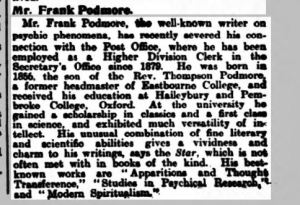
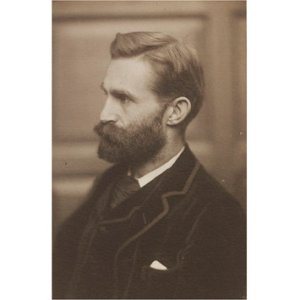
Frank Podmore’s final years were complicated.  The Lake Herald of 14th June 1907 reported that Podmore had severed his ties with The Post Office where he had been employed as a Higher Division Clerk in the Secretary’s Office since 1879.  His biographer later suggested that he had been compelled to resign from the Post Office due to alleged homosexual involvements.   During 1907 he moved to Broughton, near Kettering to live with his brother Claude leaving his wife alone in London. At the time of his death, Frank Podmore was virtually penniless, and it would be easy to conclude that he may have seen suicide as a way out of his problems.  But were they problems?  The Rugby Advertiser is one of the many papers to report that Frank Podmore returned to Ivy Cottage accompanied by a younger man – a causal acquaintance he had met during his walk and who had supper with him.  He had left his wife, and the split was permanent and bitter. She did not attend his funeral, nor did she send a wreath.  And she was not alone.  Several members of his close family failed to attend. But Podmore enjoyed a close relationship with his mother.  Both Frederic Myers and Henry Sidgwick had reputedly dabbled in homosexuality, and therefore his friends within the SPR were most likely tolerant of his lifestyle.  He had escaped what must have been a restrictive and unhappy marriage, and it may well be the case that in leaving London and his career with the Post Office, Frank Podmore had found the opportunity to be himself.  There is no evidence that he was worried or unhappy. 

So, were these deaths suicides, accidental deaths or something else?  We will probably never know.  Psychic researchers who believe in life after death, are introspective by their very nature and perhaps more prone to suicide.  And although Frederic Myers died naturally, suicide stalked his family beginning with the suicide by drowning of his lover Annie Hill Marshall in 1876 and ending with the overdose of his son Leopold Myers in 1944.  It is ironic that Myers, who died naturally and embraced his demise with enthusiasm, was a common denominator in the other mysterious deaths. 
Death of a Psychic Researcher

Edmund Gurney photoOn Friday 22nd June 1888 Edmund Gurney checked into the Royal Albion Hotel opposite the Aquarium on Brighton’s seafront. The hotel was an unusual choice for Mr Gurney. A frequent visitor to Brighton, he most commonly stayed in lodgings. Perhaps, this time, he craved the anonymity of a busy hotel. Gurney’s reason for being in Brighton was equally unclear. He had been summoned, by letter, but had not disclosed why, or by whom. His contact details were omitted from the hotel register, and he had no identification on his person, save for one unposted letter.

Edmund Gurney was a founder member of the Society for Psychical Research. A prolific writer and talented musician, Gurney had been involved with the organisation since its inception in 1882. The society investigated all manner of psychic events, cataloguing and seeking to prove or disprove their validity. Gurney had visited Brighton on numerous occasions while conducting experiments on hypnotism with George Albert Smith. Mr Smith, who later became a filmmaker, was a stage hypnotist and psychic who became Edmund Gurney’s private secretary. Together, they carried out work on telepathy and mesmerism.

Edmund Gurney 1888
So, what bought Edmund Gurney to Brighton in June 1888? Certainly not George Albert Smith who was honeymooning on the Isle of Wight. The contents of the letter summoning Gurney to Brighton were never made public although there was a suggestion that he was on Society business. In any event, he never returned to his family home in Montpellier Square London again.

At 2 pm on the afternoon of Saturday 23rd June 1888, a chambermaid at the Royal Albion Hotel raised the alarm after she could not access the room. The hotel manageress let herself in to find Edmund Gurney dead on the bed with a sponge bag over his face, and an empty bottle of a substance believed to be chloroform on the floor. At the subsequent inquest, details were given of Gurney’s insomnia and neuralgia for which he allegedly took chloroform for relief. His death was ruled accidental although later speculation suggested suicide.

But what if neither suggestion was correct?

Lawrence Harpham’s latest investigations lead from Ipswich to Brighton to Whitechapel. Find out what Lawrence concluded about Edmund Gurney’s death in The Ripper Deception.


The Fox and Goose, Fressingfield

IMG_0265Crucial to the setting of ‘The Fressingfield Witch’, is The Fox and Goose Inn which nestles in front of the churchyard. Formerly the guildhall of St Margaret of Antioch, the structure was built around 1509 and has been a public house since 1710. The side facing the churchyard is an attractive mix of brick and timbers and there is an interesting carved corner post with the figure of Saint Margaret on the church side of the building. The post, quite naturally, appears worn and I worked it into the book with one of the characters touching it for luck.

The village of Fressingfield in the book is populated with real inhabitants from the 1891 census, mostly where they do not play a lead role – and even sometimes where they do. The publican in 1891 was  63-year-old Benjamin Powley from Burlingham, Norfolk, coincidentally bearing the same name as one of my nephews. Prior to that, he was victualler at ‘The Feathers’ in North Walsham.

Though serving as a public house, The Fox & Goose regularly hosted inquests. The following, extracted from The Ipswich Journal 8th November 1884, records the inquest following the death of Jonathan Carter, an integral event in ‘The Fressingfield Witch’:

Sudden Death – An inquest was held at the Fox and Goose Inn on Monday morning before C.W. Chaston, Esq upon the body of Jonathan Carter, agricultural labourer, aged 77 years. Harriet Corbyn stated that the deceased, who was her brother, had lived with her and her husband for the last four years; he had had fair health and witness had not heard him complain. He left home about nine a.m. on Saturday to be shaved, which was the last time the witness saw him alive. Several of the family had died of heart disease. Deceased had not for a long time been attended by a medical man. Harriet King, widow, said that as she was walking through the churchyard on Saturday morning, about 10 o’clock, she noticed someone lying on the path, and on going up found it was the deceased. She spoke to him, but receiving no answer she went at once for assistance. John Edwards, baker, said that in consequence of what the last witness said to him on Saturday, he went into the churchyard and found the deceased lying as described. He breathed twice, and almost immediately afterwards expired. Dr Anderson stated that he had made an external examination of the body, and found no marks of violence. Judging from his experience and from the evidence given, he was of the opinion that death was caused by sudden failure of the heart’s action. The jury returned a verdict accordingly. 

Today, The Fox & Goose is a popular, friendly restaurant attracting a range of satisfied customers and even coming to the notice of The Telegraph. It is a far cry from the place of torture assigned to its upper floor in the book – a place where Matthew Hopkins accused Faith Mills of witchcraft and tried to extract a confession using the cruellest methods. Nowadays, the only cruelty is having to choose from so many delicious menu options. Time has moved on, in a good way.


The Fressingfield Witch…

… and it’s here courtesy of Publishnation who have helped me hit my target of publication by the end of October.

The Fressingfield Witch is a work of fiction based on a series of factual events from the 1890’s. It takes place in Suffolk, England. As usual, one or two of the characters come from my own family tree and the crime is solved with a combination of sleuthing and genealogy.  The book blurb is below:

“During the 1645 Suffolk witch trials, hundreds of innocent women were convicted. Death and uncertainty stalked the land. 

Fast forward to 1890 and two mysterious deaths in the village of Fressingfield stir up rumours of witchcraft again. Lawrence Harpham is dispatched from Bury St Edmunds to investigate. But Lawrence is still tormented by the tragic loss of his family in a house fire. Can he overcome his own demons and discover who is behind the flurry of deaths? 

The Fressingfield Witch is a fictional murder mystery based on true events. Two of Suffolk’s darkest cases of witchcraft are weaved together in one compelling story.”

The Fressingfield Witch can be purchased through the Amazon Kindle Store or  Lulu Publishing

Fressingfield Witch cover small snip