Politicians & Women’s Suffrage in Britain

Herbert AsquithIt is fascinating to read historical newspaper accounts of women’s emancipation which expose attitudes markedly different than those today.  Two contrasting newspaper articles about liberal politicians show remarkable differences in values, from which today’s politicians could draw a lesson.  The first article, reported in The Bury & Norwich Post 14 June 1898, shows a politician with considerable personal integrity, prepared to leave the Liberal Union due to their opposition to the “modest and reasonable” wish for women to have the vote.  He felt unable to serve an organisation with values so incompatible with his own.

Mr Jacob Bright on Liberalism and Women’s Suffrage

“A Cowardly and ungenerous Attitude”

The treasurer of the Manchester Liberal Union has received from Mr. Jacob Bright, formerly for many years MP for Manchester, a letter giving the reasons for not renewing his subscription of £50 to the Union.  Mr Bright writes: “Ever since I entered political life I have advocated the claim of women to Parliamentary representation.  For the last thirty years my wire, my sisters, my nieces and almost without exception, the women connected with my family, have given much labour to the cause of the enfranchisement of their sex.  I have never been satisfied with the attitude of the Liberal party towards this question.  I think it has been and is a cowardly and an ungenerous attitude.  I see that the hesitation, not to say hostility, with which certain leading liberals treat a claim so moderate and reasonable is seriously undermining the very foundations of the Liberal creed.  Considering the length of time which has elapsed since the principle and taxation and representation should go hand in hand was established, it is only just that women should be at once admitted to their share in the government of the country as they contribute to maintain.  For these reasons I have reluctantly decided that until Women’s Suffrage is seriously adopted and pressed forward as a measure of immediate Liberal policy any means at my disposal must be given to those who at great personal cost and labour, are advocating a reform which I hold to be essential.

Jacob Bright’s support for the cause is strikingly different to that of Herbert Asquith..  This may be due, in part, to the change from the peaceful tactics of the suffragists to the law-breaking of the suffragettes over the intervening years.  The attitude of Liberal Prime Minister Herbert Asquith following the second reading of the conciliation bill was reported in the Framlingham Weekly News 6th April 1912.  The conciliation bill, narrowly defeated by 14 votes, would have given voting rights to about a million women.  It was reported that, upon defeat of the bill, politicians leapt to their feet waving papers and handkerchiefs, cheering enthusiastically.  The vote was opposed by Winston Churchill and, of course, Herbert Asquith, amongst others. Asquith stated that his opposition was based on the one word, “sex.”

He said, “As a student of history and of political life, there is, in my opinion, a natural distinction of sex which admittedly differentiates the functions of men and women in many departments of human activity.  That differentiation ought to continue to be recognised, as it always has been, in the sphere of Parliamentary representation.”

Asquith was the target of many Suffragette attacks, during one of which the Downing Street windows were broken.  He fundamentally disapproved of militant action and it was not until 1917 when women ceased militancy to concentrate on the war effort, that he came around to the idea of women gaining the vote. Women over 30 or women householders over 21 were finally granted the vote by the last serving Liberal Prime Minister, David Lloyd George, in 1918.

Location #1 – Christchurch Park

View of Ipswich from Christchurch Park GainsboroughVote for Murder is set in two main locations; Stonham Aspal during 1851 and Christchurch Park, Ipswich in Edwardian times.  Suffragette Louisa Russell, cousin of Millicent Fawcett, lives in Ivry Road on the outskirts of Christchurch Park.  These two areas, together with Henley Road and Fonnereau Road, account for many settings within the book.

Christchurch Park was the former site of an Augustinian Priory disbanded by Henry Viii during the dissolution of the monasteries.  It was acquired in 1545 by Edmund Withipoll and later in the 18th century, by Claude Fonnereau.  In 1892 Felix Cobbold gave it to the City of Ipswich.

There are various monuments set within Christchurch Park, both the Brett Fountain donated in 1863 and the Burton Drinking fountain, gifted in 1895.  The same year The Cabman’s shelter was moved from Cornhill to Christchurch Park.

Vote for Murder was set in 1911.  One scene in the book describes Louisa walking past the Martyr’s Memorial:

“…The cross-topped monument stretched skywards casting a lanky shadow over the path ahead. Recently completed, the carved round pillars caught the light of the morning sun and the carved inscription stood fresh and clear.”

The Martyr’s memorial was erected in 1903 following a campaign through The East Anglian Daily Times to provide a symbol to remember the protestant martyrs.  The Ipswich martyrs were a group of men and women put to death during Queen Mary’s reign for their refusal to recognise the Roman Catholic doctrines.  Many were burned at the stake.  There are nine martyrs named on the memorial, all of whom are mentioned in Foxe’s book of martyrs.  They were reported to have met their deaths with bravery and spirit.

A cenotaph dedicated to the men and women who fell in World War I was placed in Christchurch Park in 1924 joining the Boer War memorial erected in 1906.  Further features of the park include a fountain, an ice house and an Arts and Crafts shelter known as ‘The Bandstand’.  Prince Albert visited Christchurch Park in 1851, the same year that Mary Cage was hanged in Ipswich Gaol.

Christchurch Mansion, a red brick Tudor House, still houses the museum in which furniture, paintings, and pottery can be found.  Exhibits have a strong Suffolk theme with displays by John Constable and Thomas Gainsborough and cases of Lowestoft porcelain.

Nowadays Christchurch Park is a busy, family orientated area, ideal for indulging in outdoor pursuits, sports and the Arts.  The Park enjoys strong support from The Friends of Christchurch Park.

“Oh may Thy soldiers, faithful, true and bold,
Fight as the saints who nobly fought of old,
And win with them the victor’s crown of gold.
Alleluia.”

(Inscription on the memorial to the Ipswich Martyrs)

Mary Emily Cage – Murderess or victim?

Front cover snipOn 23rd March 1851, James Cage took his last breath, poisoned to death by his wife, Mary.  The Press were quick to report on the murder and  before long produced damning reports of Mary and her ‘depraved’ character, as evidenced in the extract from the 9 August 1851 Norfolk Chronicle, below:

“It will be remembered that just before the last Assizes, Mary Emily Cage, at Stonham, was examined on a charge of murdering her husband, by poisoning him.  The case was remanded until the Summer Assize, and at half-past eight o’clock on Saturday last, the wretched woman was placed at the bar to take her trial for the offence.  She exhibited little alteration in her appearance.  It is not our intention to lift the veil from the domestic history of this woman, any further than the trial itself removed it, for unfortunately there is not a feature in it that is not degrading to our common humanity. – Messrs. Power and Mills prosecuted; Mr. W. Cooper defended.

The case presented features of great depravity.  The deceased was an agricultural labourer, and with his wife, the prisoner, lived at Stonham Aspal.  They had a family of seventeen children, but one of them, now a lad of twenty years of age, was not the result of wedlock.  The deceased was imprisoned twelve months, and during his incarceration she cohabited with another man, and the result was the birth of the boy.  During the last eighteen months, she left her husband not less than three times, and exposed her daughter, sixteen years of age, to be debauched.  In other respects she led a very dissolute and depraved life…”

Vote for Murder” is a murder mystery based on Mary’s life . It takes a more sympathetic view of her behaviour than the Victorian press, taking into account the abject poverty in which she found herself.  The murder of James Cage contrasts with the second (fictional) murder set in a comfortable, middle-class household close to Christchurch Park in Ipswich.  Both lead female characters are headstrong; Mary determined to behave as she sees fit despite the social conventions of the time and Louisa, a suffragist campaigning for the right of women to vote.

Vote for Murder is a work of ‘faction’, where historical fact meets fiction.  From the first moment I read the Mary Cage story many years ago, the circumstances of the crime did not ‘feel’ as black & white as the press implied.  Vote For Murder is my fictional interpretation of Mary’s life and times.

Vote for Murder is now available through the Amazon Kindle Store http://tinyurl.com/pbpzehr

“There can be no peace until women get the vote”

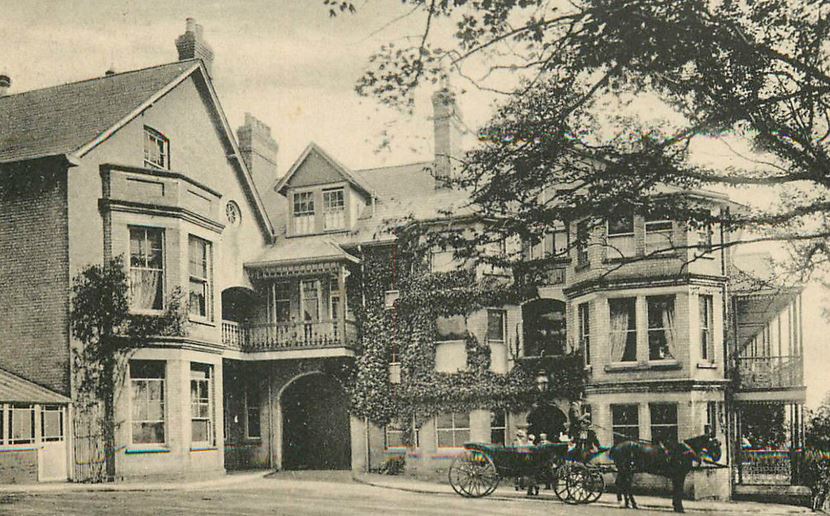
Bath Hotel FelixstoweIn Vote for Murder, Louisa Russell witnesses the unedifying spectacle of Clara Delaney enduring force-feeding in Holloway prison.  Though a work of fiction, this is based on numerous true accounts of the tortuous force-feeding of suffragettes who resorted to hunger strikes, willing to die for their cause.

The Bath Hotel in Felixstowe was completely gutted on 29th April 1914 when suffragettes Hilda Birkett and Florence Tunks burnt it to the ground.  The women, who refused to give their names to the police, were arrested in Felixstowe on suspicion of being involved in the fire.  When the fire was investigated, evidence of arson was soon found.   Cotton wool had been carefully placed on the broken edges of the glass window of the kitchen at the east end of the building.  It was assumed that the cotton wool was placed to avoid injury while undoing the latch. Once inside, the arsonists started fires in the bedrooms and corridors of the empty hotel.

Evidence against the suffragettes was found in the form of tie-on labels bearing inscriptions in ink in large capital letters with the slogan – “There can be no peace until women get the vote” and other similar declarations. These labels corresponded to similar labels in the possession of the suffragettes.

Hilda Birkett and Florence Tunks were tried at Bury St Edmunds in June 1914.  The women, described as ‘of superior education,’ were disruptive in court, making frequent outbursts.  Hilda Birkett “refused to recognise this Court, a Court which is entirely of men.  It is absolutely wicked and wrong that they should dare to try women.  Women are not recognised under the law.”

In the course of the trial it transpired that Hilda Birkett had been convicted in Birmingham in 1909 for damaging a railway carriage by throwing stones.  She was imprisoned again in 1912 for damaging plate glass windows and was awaiting trial for setting fire to a grandstand in Leeds in 1913.  Florence Tunks had not been convicted but she was under suspicion for other matters.

While Florence Tunks had nothing further to add before passing sentence, Hilda Birkett spoke passionately.  The Bury Free Press of 6th June 1914 reports her address to the judge thus: “…Whatever sentence you impose, I shall not serve because I have made up my mind that I will not take any food or drink while I am in prison.  I cannot stand the torture of the feeding tube for a great length of time … and if Mr McKenna does not release me I shall die in prison…”

Despite her eloquent address, Hilda Birkett was sentenced to 2 years imprisonment and Florence Tonks to 9 months imprisonment.

Following letters of support in the weeks following the trial by Ursula Hartley, member of WSPU, it transpired that before their trials both Hilda Birkett and Florence Tunks endured weeks of forcible feeding while in prison.  Ursula Hartley wrote again on 17th June 1914 to make it publicly known that the father of one of the suffragettes had been unable to locate his daughter, despite having applied to the Home Office for advice of her whereabouts.

Hilda Birkett was finally released on 1st September 1914 following the Home Office amnesty.  During her imprisonment, she was forcibly fed 292 times.

Vote for Murder – Suffragette Protest

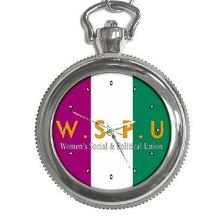
WSPU fob“One of the women in the group, notably taller than her peers, clapped her hands, “quickly now girls,” she said. “We do not want Millicent to get wind of this.”

They hurried down a wide road into a warren of alleyways and presently found themselves at a street corner. The tall woman beckoned them to stop and they stood quietly in the shadow of the wall.

“The police station is over there,” she whispered. “As soon as you have let loose run as quickly as you can in different directions, like you did before. Are you ready?”

“Ready for what?” asked Louisa, but her voice was drowned by a sea of noise as the women ran towards the red-brick station, hurling a volley of stones into the windows of the building. They cracked like gunshots in the dusky night.”

Extract from Vote for Murder

Suffragist or suffragette?

Deed not words

Vote for Murder combines a true Victorian murder with a 1911 story of suffragism and census evasion.  Both events were inspired by ancestors within my family tree.  But what is the difference between a suffragist & a suffragette?

Women’s suffrage was the struggle for the right to vote and stand for electoral office.  Throughout the nineteenth century, women had no place in politics but in the 1800’s, women began to campaign for the right to vote.  These women were known as suffragists.  My ancestor, Herbert Cowell, married Alice Garrett in 1863 against her fathers’ wishes.  Alice’s older sister, Elizabeth Garrett (later Garrett Anderson), became the first female doctor to qualify in England and Alice’s younger sister, Millicent Garrett, later Millicent Fawcett , was a prominent suffragist.

Many local suffrage societies were formed following the inception of the Sheffield Female Political Association in 1851 and in 1897 these individual units were bought together under the National Union of Women’s Suffrage Societies headed by Millicent Fawcett.   The NUWSS was mostly composed of middle class, educated women and they took a long-term, peaceful approach to gaining the vote.

In 1903 a suffragist, Emmeline Pankhurst, became impatient with this method and left the NUWSS to set up her own society, the Women’s Social and Political Union.  She employed more militant tactics and the Daily Mail coined the name ‘suffragettes’ as a term of derision.  Suffragettes were prepared to break the law to gain the vote, chaining themselves to railings, damaging property and disrupting public meetings.   They endured imprisonment and force feeding as a result of their activities.

When World War I started in 1914, all suffrage activity ceased.  And in 1918, women over the age of 30, who met minimum property requirements, were given the right to vote.   It was only in 1928 that women achieved full electoral equality with men when voting rights were given to every woman over the age of 21.

Vote For Murder – Available Now

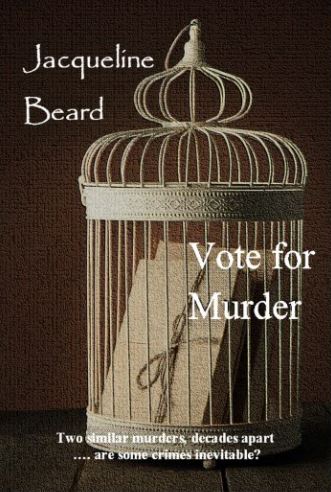
Front cover snipIn the Spring of 1911, suffragist Louisa Russell finds an old diary in a box of artefacts, while attending a census evasion night at the Old Museum in Ipswich. The diary recounts the last days of Mary Emily Cage, executed for the murder of her husband six decades earlier.

When Louisa’s next door neighbour, Charles Drummond, dies under suspicious circumstances, the parallels between the two deaths become impossible to ignore.  But can two deaths sixty years apart be linked?  And can Louisa find the poisoner before an innocent woman is convicted?

Vote for murder is based on a real poisoning by Suffolk murderess, Mary Cage.  Set in Ipswich in 1911, the novel brings together suffragism in the early 1900’s and a grisly, Victorian murder. Vote for Murder will appeal to readers of historical fiction, genealogical mysteries and Suffolk based crime books.

Available in the Amazon Kindle store now http://tinyurl.com/pbpzehr and will follow in paperback shortly.

Coming Soon…….

Vote For Murder

Front cover snipIn the Spring of 1911, suffragist Louisa Russell finds an old diary in a box of artefacts, while attending a census evasion night at the Old Museum in Ipswich. The diary recounts the last days of Mary Emily Cage, executed for the murder of her husband six decades earlier.

When Louisa’s next door neighbour, Charles Drummond, dies under suspicious circumstances, the parallels between the two deaths become impossible to ignore.  But can two deaths sixty years apart be linked?  And can Louisa find the poisoner before an innocent woman is convicted?


Vote for murder is based on a real poisoning by Suffolk murderess, Mary Cage.  Set in Ipswich in 1911, the novel brings together suffragism in the early 1900’s and a grisly, Victorian murder. Due for publication at the end of September, Vote for Murder will appeal to readers of historical fiction, genealogical mysteries and Suffolk based crime books.


Hacked Off

EAngAncMy other WordPress site has just been hacked; attacked by malicious software & closed down without warning yesterday, just like that. My web site host sent a blunt and somewhat complicated email last night; then relieved me of my monthly renewal fee this morning.

I’m still smarting at the injustice of it. I use an Antivirus; I am ultra- selective when uploading files & I run regular scans so it doesn’t seem fair that some backdoor virus has sneaked its way into the guts of my website. I backed it up, of course – but apparently I am not allowed to use the backups in case the site gets re-infected.

Did I mention it’s a genealogy site? A large genealogy site – I would tell you how large only I no longer have access to the statistics. I can still look longingly at it using the Wayback machine but it’s not the same.

I haven’t uploaded any new data for about 2 years. The site was large enough then but after 2 years of constant research & some fortunate removal of brick walls, I now have 43,892 individuals on my working tree. Take away those who may be living (bad manners to publish the living online) and those with whom I have a historical but not genetic interest, and there are still probably around 40,000 individual relatives. (Does that make me a record breaker in family history terms?)

It took me forever to upload half as many records two years ago and website hosting isn’t free, so I wonder whether it is worth all the time and frustration to put it back together again? And is there any point in a world where websites are destroyed just because somebody can?

I am a writer as well as a genealogist and am currently editing my first book for adults. It is a murder mystery set in the heart of Suffolk, beginning in the 1850’s and concluding during the 1900’s when the suffragettes were active in East Anglia. It is not only based on a true story, but features some of my relatives on www.eastanglianancestors.co.uk – or who would be featured if the site still existed. I would have enjoyed bringing the two ideas together.

So I’m licking my wounds and wondering whether to go through the painful process of reviving my dead website – or let it rest in peace. I am undecided; feedback would help. If you have relatives in Norfolk or Suffolk; if the names Bird, Fairweather, Corben, Dennis or Kersey have any meaning to you, drop me a line. My fragile ego needs stroking before I decide to grit my teeth and get on with it, or consign the website to history.

Update:  It has taken a few days to get over myself, but I have stopped sulking long enough to re-instate the website & although it has taken the best part of 4 days, it was nowhere near as difficult as I first thought.  The original website is back.  I will try to update the last 2 years worth of research in the near future.